Transient vs Homestay in Baguio: The Real Difference (From an Owner Who Runs One)
You've been searching for a place to stay in Baguio, and two words keep showing up: transient and homestay. The listings use them like they're interchangeable. They're not.
I run V.O.S. Valencia Baguio Transient House. My mom and I have been hosting guests here since 2019, and I can tell you that the difference between a transient and a homestay isn't a technicality — it decides whether your trip feels like your own private getaway or like being a polite guest in a stranger's house.
A lot of people only learn the difference the hard way: they book the wrong one, arrive, and realize too late that it wasn't what they pictured. So here's the honest version, from someone who actually runs one of these places — what each one really is, who each one is for, and why, for most Baguio trips, a transient wins on the two things that matter most.
The Difference in One Sentence
Here's the cleanest way I explain it to guests:
In a transient, the space is yours. In a homestay, you share the space with the people who live there.
A transient house is a short-term rental. You book a private room, the owner doesn't live in your space, and for the length of your stay the place functions as yours. You come and go on your own schedule. Nobody's family is in the next room cooking breakfast on their timetable.
A homestay is exactly what the word says — you stay inside someone's home while they're living in it. You usually rent one bedroom inside an occupied family house and share the common areas: the living room, often the kitchen, and sometimes the bathroom. The host family is part of the experience.
Both are legitimate. Both are cheaper than hotels. Both are family-run. But they create completely different trips — one gives you independence and privacy, the other gives you immersion and company. Most travelers want the first and book the second by accident, because the listing just said "affordable."
Quick test before you book: ask the host directly — "Will you or your family be living in the house during my stay?" If yes, it's a homestay. If the room is yours alone, it's a transient.
What a Transient House Actually Is
A transient house is a purpose-run short-term rental. The rooms exist to be rented — they're not somebody's spare bedroom that happens to be free this weekend.
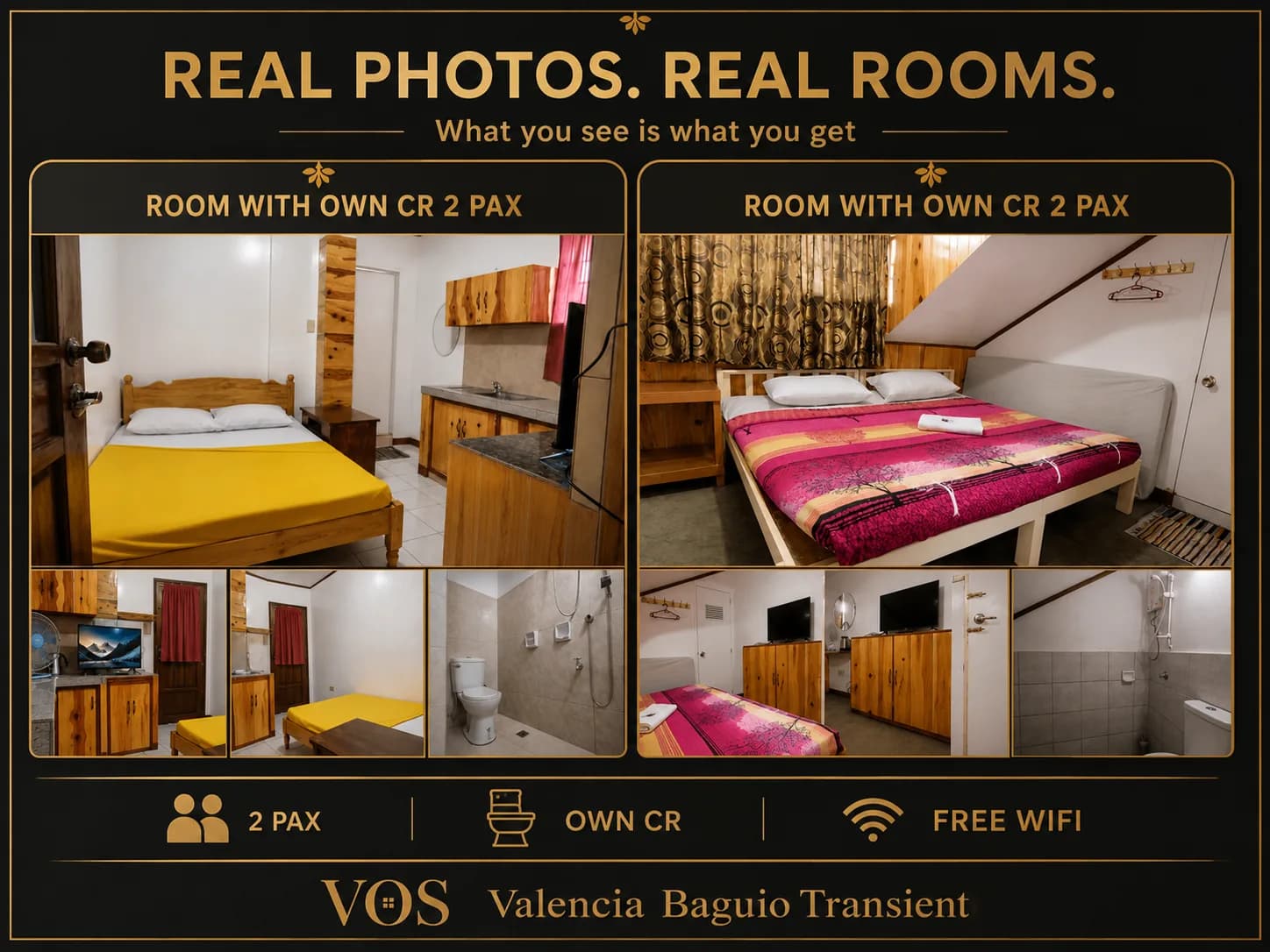
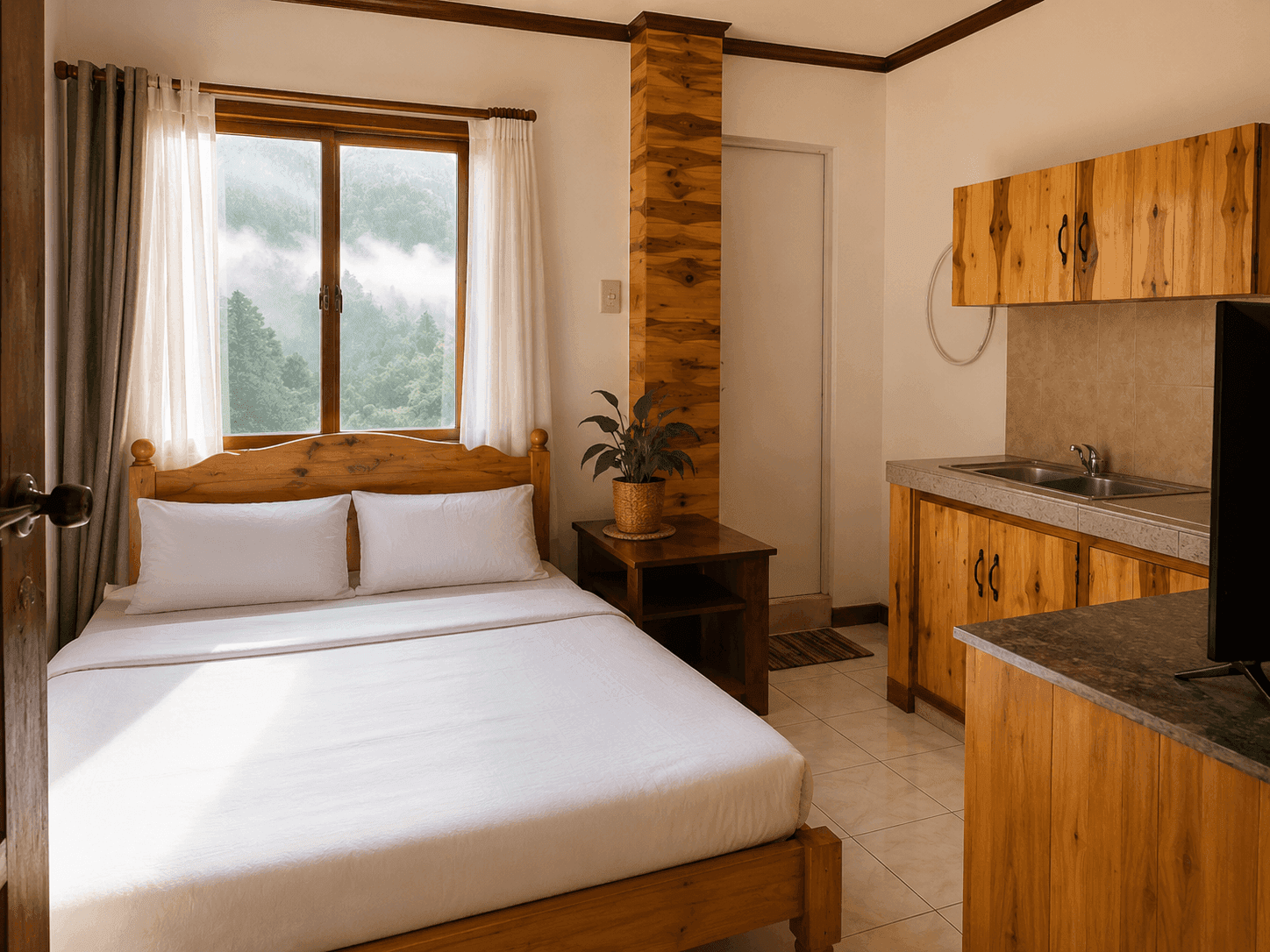
At V.O.S. Valencia, when you check in, your room is yours. You get a private room, fresh linens, hot and cold shower, free high-speed Wi-Fi, and a 3-minute walk to Session Road and SM Baguio. My mom and I run the place and we're around when you need us — but we're not living in your room with you, and we're not asking you to fit into our family's daily routine.
That distinction is the whole point. A transient gives you hotel-style independence at a transient-house price. You can come back from the night market at midnight without worrying about waking a household. You can sleep in. You can have your barkada over without feeling like you're intruding on someone's home. The space behaves like your own, because for those few nights, it is.
This is also why transients work better for groups. A homestay usually has one or two spare rooms inside a lived-in house. A transient is set up to host — so a family or a barkada can actually fit, with the room configurations and bathrooms to match. If you're traveling as a group, that difference is the whole ballgame — I broke down how it works for bigger groups in Baguio Transient House for Families.
Tip: A real transient publishes its rooms and rates and gives you a clear address. If a listing only offers "a room in our house" with shared common spaces, you're looking at a homestay — judge it on those terms.
What a Homestay Actually Is (And When It Wins)
I'm not going to tell you a homestay is bad. For the right traveler, it's genuinely the better choice — and pretending otherwise would be dishonest.
A homestay is staying inside an occupied family home. You rent a bedroom, share the common spaces, and the host family is part of the deal. The best homestays come with real warmth: home-cooked food, a host who tells you which carinderia the tourists never find, and a built-in feeling of safety because someone is always home. For a solo traveler who came to Baguio to slow down — or who just doesn't want to be alone in a strange city — that company can be the entire reason to go.
A homestay is the better call if:
- You're a solo traveler who wants conversation and local immersion
- You're staying long-term — weeks, not nights — and want a lived-in, home-cooked-meal feel
- Cultural connection matters to you more than privacy
- You're on the tightest possible budget and genuinely don't mind shared space
The honest trade-off is privacy. You're living on the household's rhythm. There may be house rules about noise, kitchen use, curfews, or visitors. The bathroom might be shared with the family, not just other guests. And the warmth that makes a homestay charming for a solo traveler is the same thing that gets in the way of a couple who wants a quiet morning alone.
The Story That Taught Me This Best
This is the one I think of whenever someone asks me the difference, because it explains it better than any definition.
A couple messaged me mid-trip, on a weekday. They'd booked two nights at a homestay for their anniversary — it looked beautiful in the photos, and it was cheap. The host, they said, was genuinely kind. That wasn't the problem.
The problem was that it was the host's family home, fully lived in. The walls were thin. The one bathroom was shared with the household. Breakfast was at a set hour with the family — charming once, awkward when all you want is a quiet morning with your partner. They felt like polite guests in someone's house, which is exactly what a homestay is. But for their anniversary, what they actually wanted was to be left alone.
They checked out a night early and moved to a private room here. After their first morning, they told me: this is what we were looking for. Same city, similar money, completely different trip. They slept in, used their own shower whenever they wanted, and walked to Session Road for coffee on their own schedule.
They weren't unhappy because the homestay was bad. They were unhappy because they'd booked the wrong category for the trip they wanted. That's the real lesson — it's rarely transient vs homestay on quality. It's transient vs homestay on fit. For couples specifically, I wrote a full breakdown of why a private room changes the whole weekend in Baguio Transient House for Couples at ₱999.
Tip: Anniversaries, honeymoons, and any trip where privacy is the point are almost always a transient call. The household setting that makes a homestay warm is the same thing that makes a romantic weekend feel observed.
Privacy and Value: The Two Things That Actually Decide It
Strip away the labels and almost everyone is really deciding on two things: how private do I want to be, and what am I getting for my money.
On privacy, the transient wins for most travelers, and it isn't close. Your own room, your own schedule, no household to tiptoe around. A homestay asks you to fit into a living family's day — a feature if you want company, a problem if you don't.
On value, the math surprises people, because homestays look cheaper at first glance. A homestay room might list lower per night for one or two people. But value isn't the headline number — it's what you get and who's traveling.
For one or two budget solo travelers who want immersion, a homestay can genuinely be better value. For a couple, a family, or a group, the transient pulls ahead fast. When you can put your whole group in one place with the right setup, the per-person cost drops below what splitting a single homestay's spare rooms — with one shared family bathroom — could ever give you.
And there's a hidden cost homestays rarely mention: location. A lot of Baguio homestays sit in residential barangays 20 to 30 minutes from Session Road, because that's where the family homes are. The room is cheap; the daily Grab and jeepney rides into the city are not. A central transient that costs a bit more per night often costs less per trip once you count transport — and the hours of your trip you'd otherwise lose commuting.
Tip: Always price the whole trip, not the nightly rate. A cheap room 25 minutes out can quietly cost you ₱150–₱300 a day in transport and an hour each way. A central transient you can walk from usually wins on total cost.
A Word on Trust and How the Place Is Run
One more difference that affects you as a guest, even though it sounds like paperwork: how the place is actually run as a business.
Many established transient houses operate as registered short-term rentals — fixed address, published rates, a real review history. Homestays range more widely: some are well-run and registered, others are informal "rent out the spare room" arrangements sealed with a handshake. Neither is automatically better, but it changes how much recourse you have if something goes wrong, and how much you can trust the listing's claims.
The guidance is the same either way: book the place that's transparent. A real address you can check on a map. Recent reviews that mention specifics. A host who replies fast and answers direct questions without dodging. That last one matters more than people think — a host who takes a day to answer your question before you've paid will take just as long to fix a problem during your stay. (There's a real upside to a place where the owners are hands-on but the room is still yours — I get into it in What a Family-Run Transient House Is Really Like.)
Tip: Transparency beats category every time. A transparent homestay can be a great stay; an evasive transient can be a bad one. Demand a real address, real reviews, and fast replies — whichever word the listing uses.
So Which Should You Book?
Here's the decision the way I'd give it to a friend.
Book a TRANSIENT if:
- You're a couple, family, or group — privacy and space matter more as the numbers grow
- You want to come and go on your own schedule, with no household to consider
- You want to be walking distance to Session Road, SM, and Burnham Park
- You want a private room, hot shower, and fast Wi-Fi at a fair price
- The trip is the point — anniversary, birthday, barkada weekend, family vacation
Book a HOMESTAY if:
- You're a solo traveler who wants company and local immersion
- You're staying long-term and want a lived-in, home-cooked feel
- Cultural connection matters to you more than privacy
- You're on the absolute tightest budget and don't mind shared space
Then, whichever you choose, verify the basics before you pay: a real address checked on a map, the actual walking time to Session Road, a confirmed hot shower (Baguio mornings are genuinely cold — this is not optional), real Wi-Fi, and a host who answers within minutes.
Booking, and a Few Honest Recommendations
If a transient sounds like your trip, the process here is simple: message us on Messenger with your dates and headcount, we send you the available rooms, you send a small deposit to hold it, and we confirm with directions. We reply in under five minutes.
If you want to compare what's available across the city at different price points before you decide, Baguio Transient has a useful directory of houses. If you're a bigger group looking for a whole private house rather than rooms, VOS Villa is worth a look. And if you're a property owner reading this and wondering how to get more direct bookings instead of relying on the platforms, FreeUpToHours is a Philippines-based agency that does AI automation and SEO for small businesses like ours.
Frequently Asked Questions
What is the difference between a transient house and a homestay in Baguio? In a transient house the space is yours — you book a private room, the owner does not live in it, and you come and go on your own schedule. In a homestay you rent a bedroom inside an occupied family home and share the common areas while the host family lives there.
Is a transient or a homestay better for couples in Baguio? For couples, a transient almost always wins. It gives you privacy, your own bathroom, and your own schedule — what most couples actually came for. A homestay's lived-in household setting, while warm, tends to make a romantic weekend feel observed.
Are homestays cheaper than transient houses in Baguio? A homestay room can look cheaper per night for one or two people, but value depends on who is traveling. For a couple, family, or group a transient pulls ahead. Many homestays also sit 20–30 minutes from Session Road, so daily transport can quietly cost more than a central transient.
When is a homestay the better choice in Baguio? A homestay is better for a solo traveler who wants company and local immersion, for long-term stays with a lived-in, home-cooked feel, when cultural connection matters more than privacy, or when you are on the tightest budget and do not mind shared space.
How do I know if a listing is a transient or a homestay? Ask the host directly: "Will you or your family be living in the house during my stay?" If yes, it is a homestay. If the room is yours alone for your stay, it is a transient. A real transient also publishes its rooms, rates, and a clear address.
The Bottom Line
A homestay and a transient are not the same thing, and the cheaper headline price isn't the real comparison. A homestay gives you company and immersion — perfect for a solo traveler or a long, slow stay. A transient gives you privacy, space, and your own schedule — which is what most couples, families, and groups actually came to Baguio for.
Decide on the trip first, the category second. Name what you really want — privacy or immersion, space or company — and the choice between transient and homestay makes itself.
And if it's privacy you're after, you already know where to message.
Oliver Valencia
Co-owner, V.O.S. Valencia Baguio Transient House
LinkedInOliver and his mother have been running V.O.S. Valencia in Baguio City since 2019. Having hosted 50k of guests — couples, families, barkadas — Oliver writes from real local experience. If you have questions about visiting Baguio, he's the person to ask.